
BVM Handcrafted
Thank you for reading this post, don't forget to subscribe!Globalization has created different legal spaces: free ports, tax havens, and special economic zones. Entrepreneurs see an opportunity with these new spaces to escape the bonds of democratic government and oversight by creating what is termed a “network state.”
The network state is a concept cultivated by influential and wealthy people (Joseph Lonsdale, Peter Thiel, Garry Tan, David Sacks, among others) who believe technology will collapse the economies of nation-states and democracies by sucking all the jobs and revenue out of them.
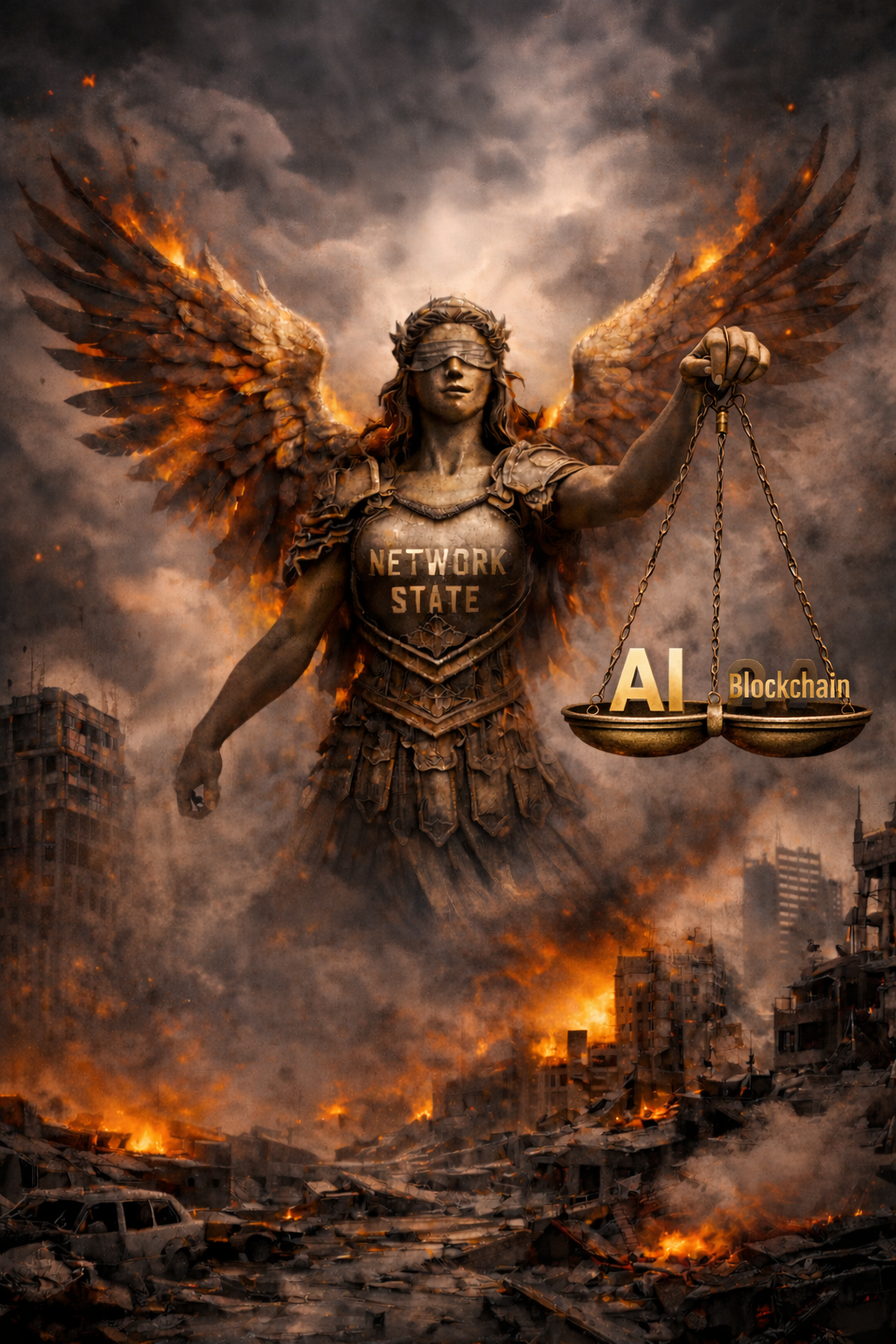
As the nation states die, they theorize, there will be chaos and violence. The network state concept emerged as a movement to create privatized cities that would be their own “countries” capable of surviving collapse.
And, by the way, adherents of the network state believe it’s their job to help cause the collapse. This is called “acceleration.” They believe capitalism must accelerate toward “maximum destruction,” and that’s the only way to develop AI-enhanced societies properly.
Greenland is a territory where Dryden Brown, the head of a company called Praxis, has proposed a network state. Brown says he has $525 million in financing to build this enclave. The investors include Mark Andre, Peter Thiel, Sam Altman, and the Winklevoss twins.
Pop Up Cities
Tech sector elites have long expressed their desires to escape regulation and, as they see it, a failing democracy. The allure of tech-friendly havens unbound by legacy rules and regulations is attracting frustrated tech billionaires and millionaires.
“This whole movement is about reinventing governance for the 21st century, inspired by start-ups and the internet,” says Patri Friedman, grandson of free-market economist Milton Friedman and founder of Pronomos Capital, a venture firm that invests in experimental cities.
Friedman seeks to create cities that operate like for-profit companies rather than under democratically elected officials. It’s reminiscent of Ayn Rand, who in Atlas Shrugged imagined a free-market enclave called Galt’s Gulch. The idea to create sovereign mini-countries, each governed by its own joint-stock corporation, is a challenge to global order. However, traditional forms of governance will not be in play. “We are funding companies that will operate non-democratic cities,” Friedman says. “And if you’re not into that, you shouldn’t move there.”
One of the most advanced network state experiments is the Próspera domain. It is a gated private community in Honduras run by a Delaware-based company. The vision is to have a place where 1,000 residents can enjoy co-working spaces, a beach resort, and a golf course. As a “for-profit semi-autonomous zone,” Próspera will have low taxes, its own labour rules, and an arbitration system run by retired Arizona judges who hear cases online.
Another iteration of the network state is the “pop-up city,” which is a sort of weeks-long temporary brainstorming town. In 2025, Edge City hosted a month-long pop-up in Patagonia. Five hundred attendees, or “residents,” took part in projects focused on artificial intelligence and longevity.
The idea of the pop-up city is to create a space for what Ethereum founder Vitalik Buterin calls a “micro exit.” This is a temporary exit to experiment, and then “go back and spread those learnings around the world,” as Timour Kosters says, co-founder of Edge City, which advertises itself as a “society incubator.”
Praxis, besides eyeing Greenland, recently announced plans to start a permanent “defence-focused spaceport city” called Atlas at Vandenberg Space Force Base in California, which already houses Musk’s SpaceX and Jeff Bezos’s Blue Origin.
The Genesis of the Network State Concept
The principal architect of the network state is Balaji Srinivasan, the former chief technology officer of Coinbase. He reimagined nations as digital communities. His theory is that internet companies, internet currencies, and internet communities will eventually fuse with nation-states.
By leveraging cryptographic security, Decentralised Finance (DeFi), smart contracts, and Decentralised Autonomous Organisations (DAOs), Srinivasen sees network states as parallel institutions that offer greater autonomy and resilience against censorship or coercion.
There are now various companies working towards the idea of a network state, including Praxis, Zuzalu, Prospera, and Nation3.
Srinivasen’s network state prioritizes shared values and digital connection over physical borders, “aiming to achieve sovereignty through collective action and economic strength,” much like a startup society built from the internet up.
In 2025, Srinivasen held a Network State Conference in Singapore, where Ethereum, Coinbase, Solana, Telegram, and many others gathered to discuss how to materialize their cloud communities into the physical world.
How The Network State Works:
- Gather like-minded people online who share a vision and set of values.
- Develop an internal economy, currency, and governance (like a DAO).
- Collectively purchase or build physical properties (houses, apartments, land) globally.
- Digitally connect these scattered physical locations into a single, unified “state”.
- Leverage its size and coherence to demand and eventually achieve sovereign status.
CONCLUSION
The principles championed by the cypherpunk movement of the 1990s laid the foundation for using encryption to secure privacy, resist surveillance, and empower individuals against centralized control.
The network state sees itself as the fruition of cypherpunk ideologies. This digitally coordinated society can establish its own economic and political framework, ultimately challenging nation-states’ monopolies over governance and sovereignty.
The appeal of the network state lies in the ability to create new systems of governance and societal organisation without being constrained by historical legacies or bureaucratic inertia.
Encrypted messaging platforms, peer-to-peer data exchanges, and blockchain-based identity systems will allow network states to function while resisting external pressures to create, as Balaji Srinivasen says, “a future in which individuals have greater agency over their financial, political, and social lives, reshaping the landscape of statehood itself.”
SOURCES
Articles:
- Tech elites are starting their own for-profit cities https://www.ft.com/content/b127ee7a-5ac4-4730-a395-c9f9619615c7
- Network States – Revolutionary Idea To Potential New Asset Class https://www.forbes.com/sites/digital-assets/2023/12/20/network-states–revolutionary-idea-to-potential-new-asset-class/
Books:
- Crack-Up Capitalism: Market Radicals and the Dream of a World Without Democracy by Quinn Slobodian
- Adventure Capitalism: A History of Libertarian Exit, from the Era of Decolonization to the Digital Age by Raymond Craib
- The Philosopher in the Valley: Alex Karp, Palantir, and the Rise of the Surveillance State by Michael Steinberger
Other:
- The Network State Conference https://www.youtube.com/playlist?list=PLJg2RipiXz8oDoMPCsmOVI_UEaSNbgjA6
- balajis.com / https://balajis.com/p/network-state-conference
- Lucid Q&A with Ruth Ben-Ghiat and Gil Durán https://www.youtube.com/watch?v=AI5aJhTVjVo
- Mountainhead: 2025 movie written and directed by Jesse Armstrong


0 Comments