
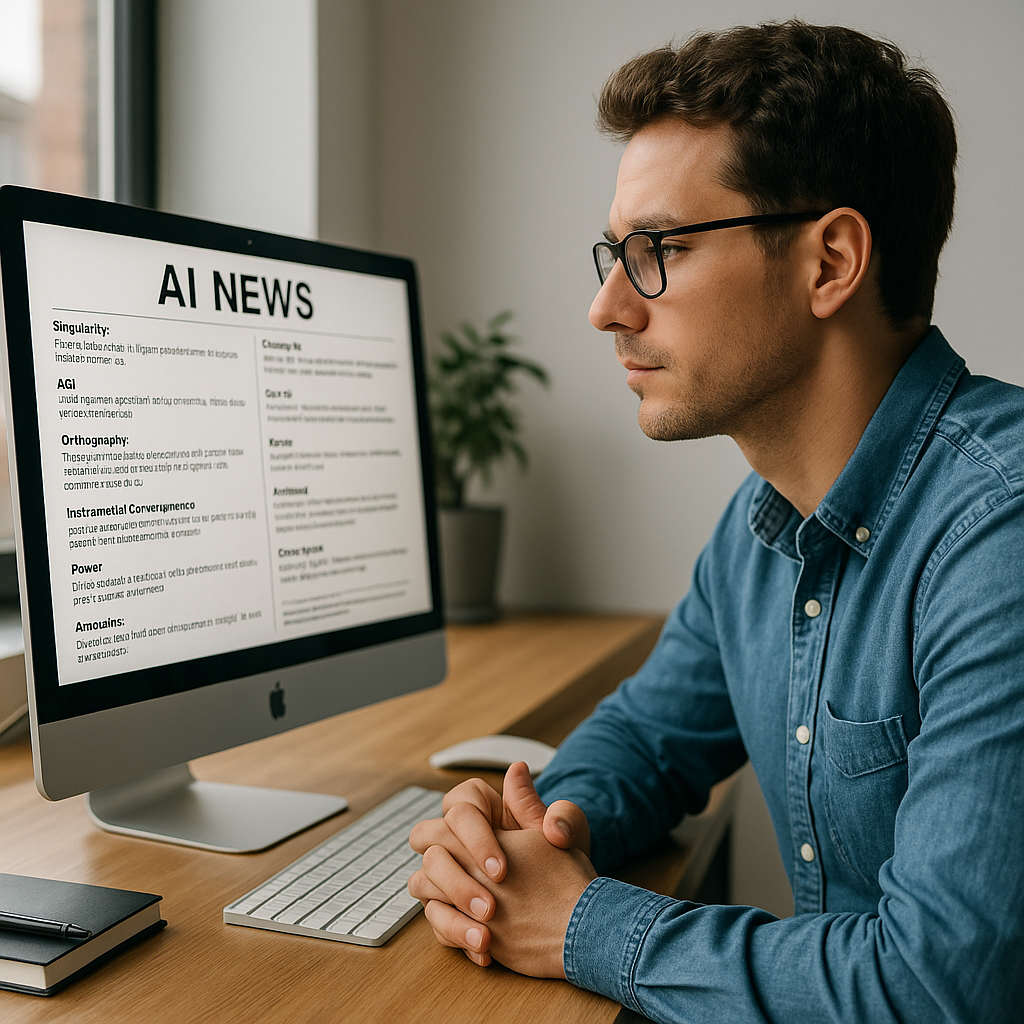
At BridgeView Marketing, we are committed to staying in lock-step with the latest developments in AI. While some of this news directly informs our clients’ thought leadership, other developments are simply fascinating. Here’s a sampling of AI news we’ve found interesting enough to share, although not all of it is directly relevant to our client-based content writing.
Thank you for reading this post, don't forget to subscribe!First: Some Terms
Singularity—a hypothetical future point when AI surpasses human intelligence
AGI—an AI system capable of doing everything the human brain can
Orthogonality—the notion that intelligence and benevolence are separate traits, and that an AI system would not automatically get friendlier as it gets smarter
Instrumental Convergence—the idea that a robust, goal-directed AI system could adopt strategies that end up harming humans
———————————–
Copyrights
On June 23, 2025, the landmark decision Bartz v. Anthropic held that using copyrighted books to train large language models (“LLMs”) qualifies as fair use when the books are lawfully obtained. However, the use of unlawfully obtained, pirated copies of those books did not constitute fair use in the same manner.
Avatars
Chinese virtual human salespeople are outperforming their real human counterparts. Shanghai-based marketing company, PLTFRM, says it has deployed avatars across Chinese e-commerce sites like Alibaba’s Taobao and Pinduoduo, the sister site of Temu. These avatars rely on AI video models and large language models to generate scripts. They are programmed to share basic information about what they’re selling, as well as greet the audience and respond to questions. Companies switching to AI avatars are seeing sales rise by up to 30 percent.
A recent report by the online creation platform Kapwing found that computer-generated celebrities are amassing millions of followers — and dollars — for the teams behind them. An AI influencer named “Miquela” has appeared on magazine covers, released music, and served as the face of campaigns for Calvin Klein and Prada, all while purporting to be a Brazilian American teen from Downey, Calif.
Growth
AI spending is propping up the U.S. economy. The trillions of dollars that tech companies are investing in new data centers are starting to contribute to economic growth. The substantial investment in data centers, semiconductor factories, and power supply required to build the computing power that AI demands is boosting the U.S. economy. Investment in software and computer equipment, not counting the data center buildings, accounted for a quarter of all economic growth this past year, data from the Commerce Department shows.
Power
Electricity rates for individuals and small businesses could rise sharply as Amazon, Google, Microsoft, and other technology companies build data centers and expand into the energy business. Computers training and running AI systems consume far more energy than machines that stream Netflix or TikTok. A rush to build power plants and transmission lines is on, as big tech companies pivot to AI, and this boom threatens to drive up power bills for residents and small businesses.
Doctors
Physicians are using AI for diagnoses. It has aided them in spotting cancer, to make diagnoses faster, and helped them more accurately predict who’s at risk of complications. However, a study found that after just three months of using an AI tool designed to help identify precancerous growths, doctors were significantly less effective at finding the growths on their own.
Artificial intelligence is being used to detect hidden signs of consciousness in comatose patients, and it is identifying these signs long before doctors notice them. Using an algorithm, the researchers were able to analyze patients’ facial movements, including tiny changes that were too discrete to be visually noticeable, but could be clinically meaningful. Known as “covert consciousness,” people in this state can respond to cues through their brain activity, even as they appear to be completely comatose.
Antitrust
To help resolve a monopoly issue, a judge ordered Google to share its search results with competitors. In an attempt to level the tech playing field, Google was ordered to hand over some of its search data to rivals. The ruling in United States et al. v. Google, LLC. comes as generative artificial intelligence is threatening to replace traditional search engines. The judge wrote that the emergence of generative AI “changed the course of this case.”
On August 25, 2025, Elon Musk filed a lawsuit against Apple and OpenAI. The suit alleges that the partnership between Apple and OpenAI is an anti-competitive conspiracy meant to stifle rival AI companies and protect the iPhone’s dominance by manipulating App Store rankings to favor ChatGPT. As of the time of writing this article, the case is in its early stages.
Hallucination
A recent paper from OpenAI researchers sheds new light on why large language models (LLMs) are prone to “hallucination,” or fabricating information. According to the paper, the evaluation methods that major AI companies use encourage overconfidence. Performance tests often take the form of multiple-choice questions. Correct answers can unintentionally reward models for guessing. By optimizing their systems to achieve a high score on these evaluations, AI companies are training their models to be good test-takers instead of actually improving their overall accuracy.
AI gets criticized because it makes up information that appears to be factual, known as hallucinations. In science, however, AI hallucinations can be remarkably useful. One of the most significant breakthroughs aided by AI is protein folding prediction, which accurately predicts the 3D structure of proteins. This fundamental molecular process greatly accelerates drug discovery and the understanding of diseases. In October of 2024, David Baker shared the Nobel Prize in Chemistry for his pioneering research on proteins. Dr. Baker said his lab had taken a new step forward in creative imaginings with AI. The Nobel committee praised him for discovering how to build entirely new kinds of proteins not found in nature, calling his feat “almost impossible.”
Apocalypse
Eliezer Yudkowsky wants to shut it all down. For the past 20 years, he’s been warning AI insiders about its danger; now he’s going public with his message that building powerful AI systems is a terrible idea, one that will end in disaster. “If any company or group, anywhere on the planet, builds an artificial superintelligence using anything remotely like current techniques, based on anything remotely like the present understanding of A.I., then everyone, everywhere on Earth, will die,” he writes.
CONCLUSION
The printing press was a significant advancement for propagating the news. However, with the truth came a lot of lies–so much disinformation was being spread in 17th-century England that King Charles banned publications from all foreign presses. The combustion engine drove the Industrial Revolution and trains across continents; it also contributed to air pollution and greenhouse gas emissions. The telephone allowed us to talk to grandma, but it also permitted marketing scams. Splitting the atom ushered in an era of nuclear fission, behind the ability to generate massive amounts of clean, carbon-free electricity; it also killed many.
The era of AI is here. Its benefits and detriments have yet to be fully worked out — and both depend on what we do (and don’t do) now.